A woman working in an art studio, mixing paints on a cluttered table with various paint jars, brushes, and art supplies.

Biography

Addy Gardner is a British artist whose practice centres on the emotional, psychological, and ecological dimensions of wildness. Her work draws deeply on her relationship with natural places, guided by the belief that rewilding and restoring natural environments is integral to the future of our world. Gardner is particularly interested in the human impulse to seek out nature, recognising within herself a profound, almost primeval longing for landscapes that feel visually and mentally expansive. This sense of openness and reconnection forms the core language of her paintings.

Originally trained in art following an Art Foundation, Gardner was set to pursue a BA in London but instead chose to study psychology, an academic shift prompted by a desire to make sense of a significant family event. Her background in psychology now plays an important role in her artistic approach, informing her understanding of nature, wellbeing, and self-actualisation. This influence is especially evident in the titles of her works, which often reference her personal connections to the landscapes she depicts. She has also expanded her ecological focus through studies in Art and Ecology at Node in Berlin.

Gardner returned to painting full-time after becoming a mother in 2007, crediting her children with giving her the confidence and resolve to pursue her artistic career with renewed commitment. Since then, she has exhibited widely in solo and group shows across London, Oxford, Edinburgh, and Plymouth, in both gallery contexts and as a self-represented artist. Her practice has included two artist residencies, membership of the Plymouth Society of Artists, and the selection of her work for a well-known home improvement television programme. She also aspires to pursue a master’s degree in the future.

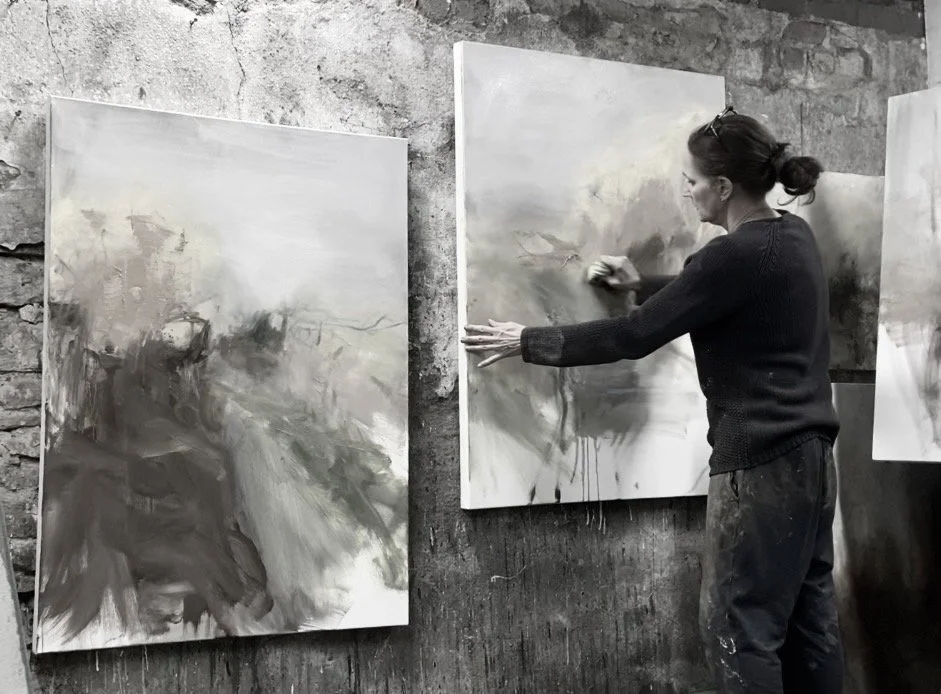
Working primarily in mixed media, Gardner creates semi-abstracted landscapes using oil paint, collage, and textural experimentation. Her collage materials often originate from the environmental books she avidly reads, embedding layers of meaning within the work. She is passionately engaged with the physicality of oil paint and the expressive possibilities of mark-making, embracing each canvas as a dynamic response to landscape.

Gardner’s work is held in private collections throughout the UK and internationally. She lives and works in Oxfordshire, creating from her studio situated at the edge of her own intentionally wild garden.

Statement

My landscape paintings begin with real places, but they rarely remain fixed. I dwell and deliberately linger in the space between what a place is and what it feels like. Each work gathers not only the physical qualities of a landscape, but also memories of colour, shape, and visual fragments drawn from my life and my dreams. As I paint, one place can quietly become another, layered and reshaped by emotion, recollection, and imagination.

My background deeply informs this way of seeing. As a half Iranian woman, I have known places I could never have imagined without my heritage. I spent my summers immersed in landscapes with people who were passionately attentive to the natural world—the mountains, the sea, and the shifting sights and sounds of these environments. They were equally passionate about life: about telling stories, lingering in conversation, and reflecting on what life and love mean. These experiences shaped my understanding of landscape not as something static, but as something lived, remembered, and emotionally charged.

Earlier in my practice, my paintings were more defined in form and intention, reflecting a different relationship to place. Over time, I realised they did not fully encompass the reality of my life, my past, or the way my thoughts move, overlap, and return. As my practice has evolved, I have let go of fixed ideas of what a landscape should look like. I allow the works to become what they are. Paint begins to direct itself; lines, words, and colour trace paths across the surface, accumulating like memories. I try to give the paintings their own life, allowing intuition, chance, and instinct to sit alongside intention.

My work is informed by artists who approach painting as a physical, psychological, and emotional act. The density and persistence of Frank Auerbach’s surfaces, Anselm Kiefer’s sense of memory and history embedded in landscape, and Joan Eardley’s raw engagement with place have been particularly influential. From Peter Doig, I draw an understanding of landscape as a space of memory, ambiguity, and dream. Robert Rauschenberg’s openness to layering, collage, and the merging of lived experience into the work, alongside Willem de Kooning’s freedom of line and gesture, have encouraged me to trust movement, disruption, and the vitality of paint itself.

These paintings are less about recording a location and more about conveying my relationship to the natural world. They hold my love for it, and for the special places I return to again and again; places that offer joy, healing, routine, clarity, magic, and love. I visit them alone and with family and friends; each journey is different, yet each becomes part of an intricate web of thoughts and feelings I carry with me.

The imagery unfolds like fairytales: collaged, layered, and sometimes fragmentary. At times the narratives make sense in glimpses; at others they exist as palimpsests of visual and mental impressions. Joy, awe, adventure, story, and magic are bound together within the paint.

I make these landscapes because I do not want these places to disappear. They are central to my life, and through painting I hold onto them, allowing them to shift, breathe, and endure on the canvas. Ultimately, I hope that viewers encounter in my work not only a depiction of nature, but an invitation to re-engage with its spirit, its luminosity, its complexity, and its enduring capacity to transport.

A woman sitting on a porch with her dog, near lush plants and a wooden house exterior.

Jenny Blyth Fine Art

For those of you who know her work, you will find that Addy has moved on from what you might expect. She is painting beautiful and complex landscapes composed of layers of oil paint which individually retain both substance and translucency. The effect is to capture the fluidity of the firmament - sunlight spilling through clouds, earth and sky bathed in luminosity. Her subject is the landscape that she encounters around her which she recreates in the studio as photographic panoramic ‘sketches’. From that visual reference point, Addy creates paintings that echo her memories, thoughts, dreams and emotions – moments of ‘peak experience’. There is a strong autobiographical element in her work that colours her compositions with titles such as “The memory of the moment we first met”. An artist invites us to share their journey, yet the success of a painting is also determined by their ability to invite us to make our own. Addy Gardner is chasing beauty, and is successful on both counts.

 Moving seamlessly between configuration and abstract expressionism, Addy Gardner invites the viewer to journey between an earthly landscape and a canvas of dreams. Her painting aspires to 'peak experience' where the viewer releases their sense of self to an awareness of a greater unity. Addy commands an ability to create form, transforming the colours of earth and sky to a spectrum of light and ambivalence. Working in oil on canvas, Addy's paintings are infused with vitality, imparting energy and a sense of joy.


Addy Gardner at her show Imagine Wild at Fitzrovia Gallery London 2022